RESEARCH | ANNUAL REPORT
How AI demand, hybrid cloud, the VMware reset, and a new era of infrastructure economics are reshaping enterprise IT — plus the 10 trends every CIO should act on in the next 24 months.
The 2026 Numbers at a Glance
Five data points define the enterprise infrastructure market entering 2026. Everything else in this report is, in one way or another, a consequence of these numbers.
| Metric | Figure | Source |
|---|---|---|
| Worldwide IT spending, 2026 | $6.31 trillion (+13.5% YoY) | Gartner, April 2026 |
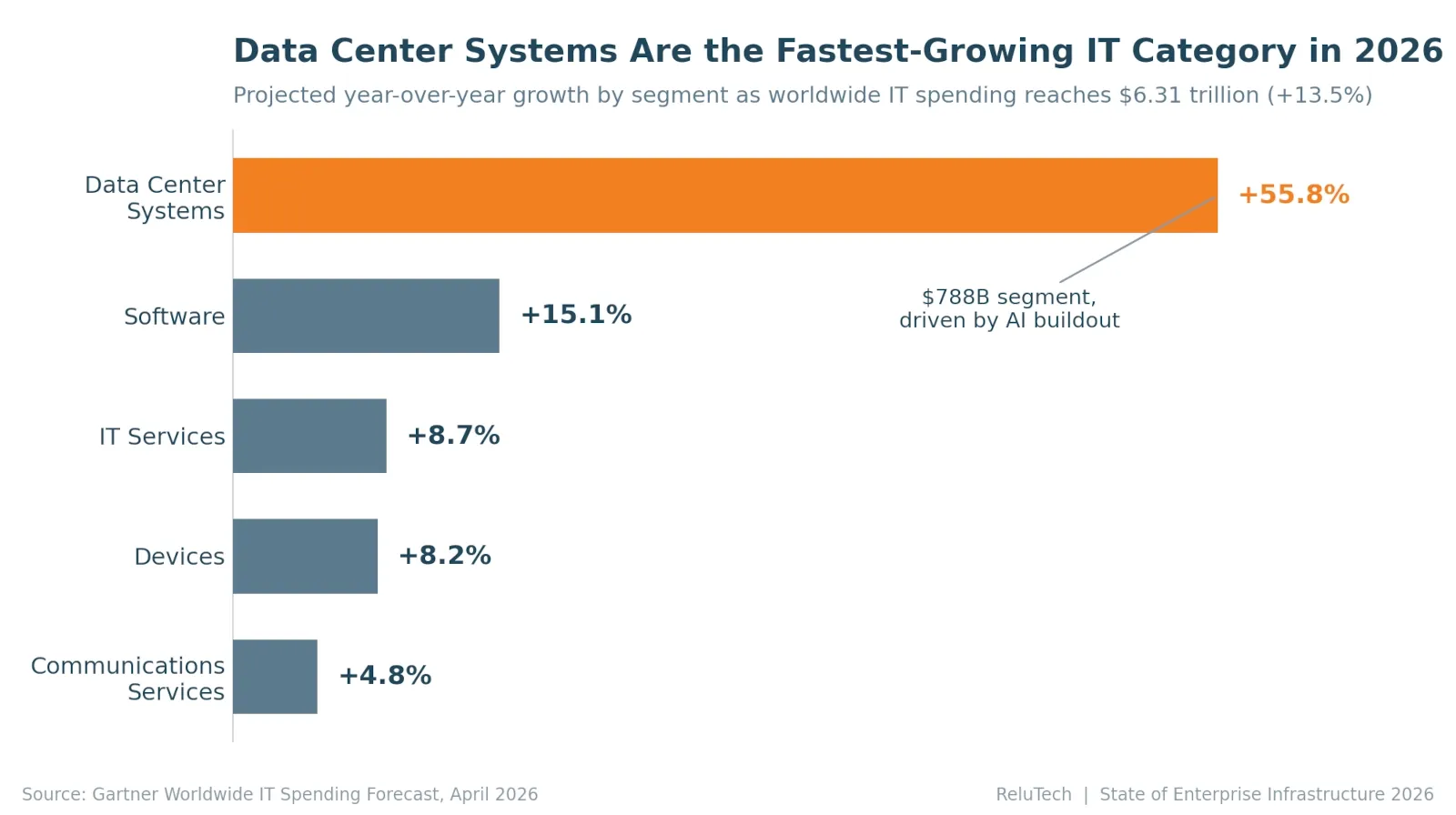
| Data center systems growth, 2026 | +55.8% to ~$788 billion, the fastest-growing IT category | Gartner, April 2026 |
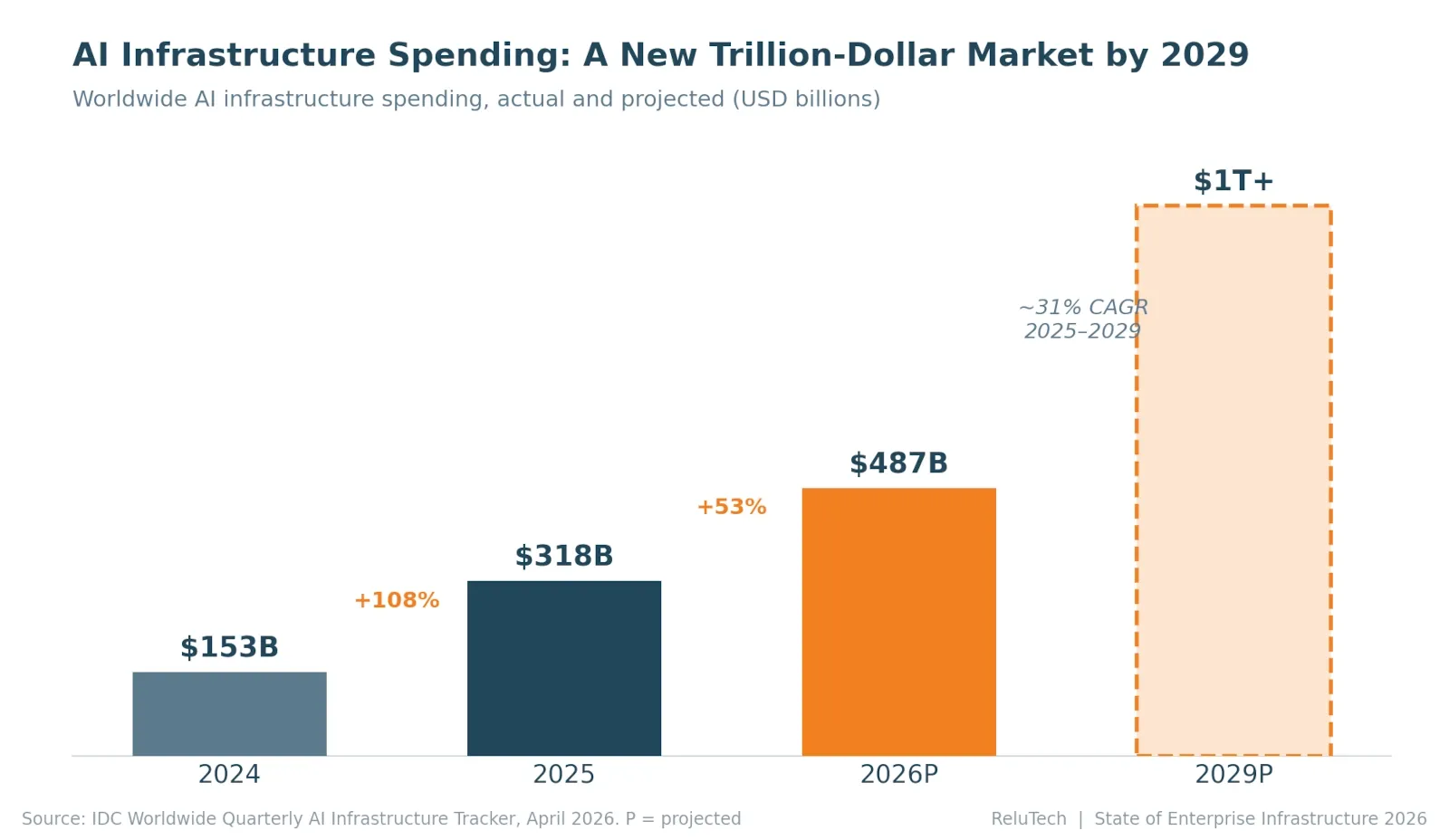
| AI infrastructure spending | $153B (2024) → $318B (2025) → $487B (2026P); $1T+ by 2029 | IDC AI Infrastructure Tracker |
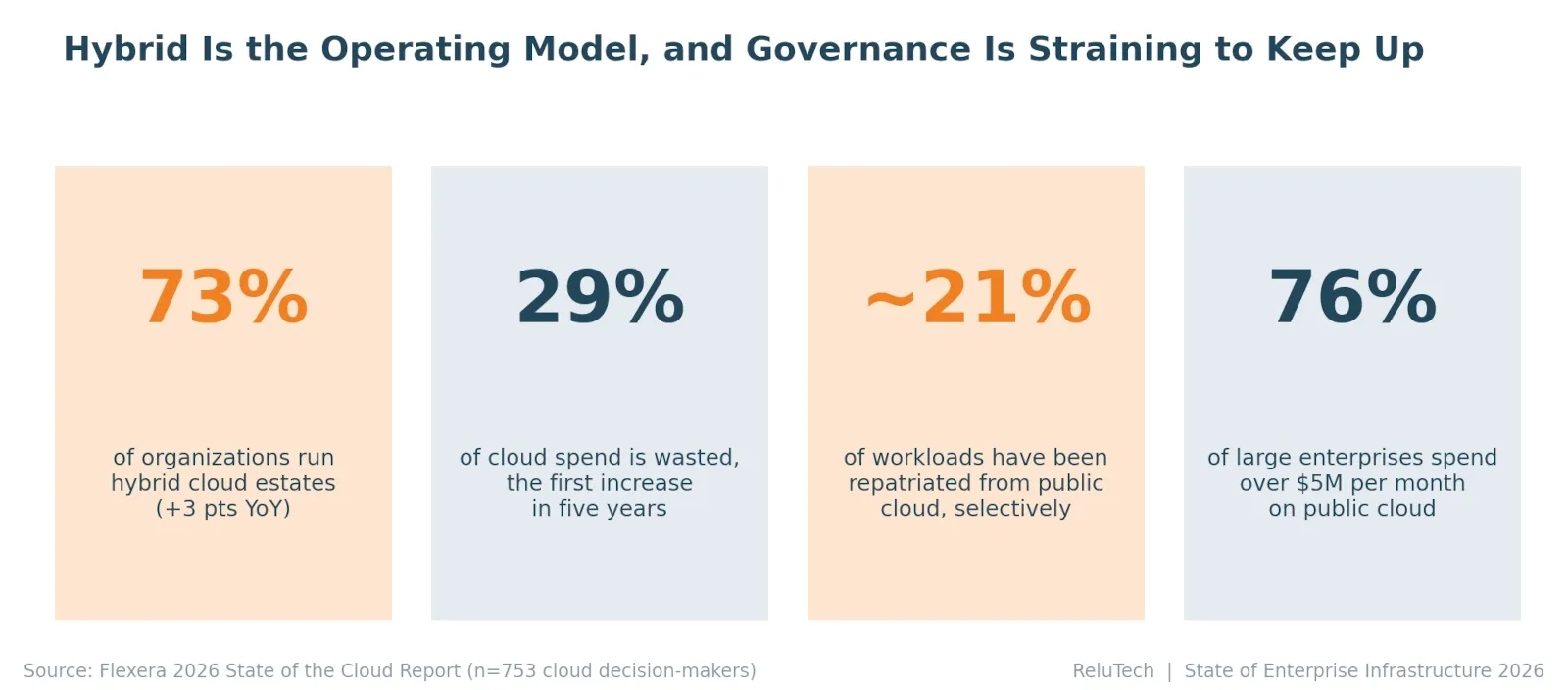
| Hybrid cloud adoption | 73% of organizations operate hybrid estates (+3 pts YoY) | Flexera 2026 State of the Cloud |
| Wasted cloud spend | 29%, the first increase in five years as AI workloads scale | Flexera 2026 State of the Cloud |
Executive Summary
Enterprise infrastructure is entering its most consequential reset since the rise of virtualization and public cloud. The prior decade was defined by migration: moving workloads to the cloud, adopting SaaS, and shrinking the corporate data center footprint. The next phase is different. AI demand is expanding the market for compute, storage, networking, power, cooling, and high-density facilities so quickly that major analysts have revised their forecasts upward multiple times within a single year.
Gartner's April 2026 forecast projects worldwide IT spending of $6.31 trillion in 2026, up 13.5% from 2025. That is a sharp upward revision from the 9.8% growth projected only six months earlier. Within that total, data center systems are growing 55.8% to roughly $788 billion, making them the fastest-growing category in enterprise IT. IDC's AI infrastructure tracker shows spending more than doubling from $153 billion in 2024 to $318 billion in 2025, with $487 billion projected for 2026 and more than $1 trillion by 2029. Flexera reports that 73% of organizations now operate hybrid cloud estates, while the FinOps Foundation finds that 98% of practitioners now manage AI spend — a signal that AI infrastructure has become a governance problem, not just a technology problem.
Yet the defining story of 2026 is not simply more spending. It is the arrival of new constraints. Power availability, cooling density, skilled labor, VMware licensing disruption, cloud waste, and asset lifecycle costs have all become board-level concerns. The result is a market in which organizations are simultaneously spending more and being forced to become more disciplined about where every dollar goes. Wasted cloud spend rose to 29% in 2026, the first increase in five years, precisely because AI workloads are scaling faster than governance can mature.
This report synthesizes research published between 2024 and 2026 to identify the ten trends most likely to shape enterprise infrastructure strategy over the next 24 months. The central conclusion: infrastructure has become strategic again. The winners will not be the companies that simply buy more technology. They will be the companies that place workloads intelligently, govern spend continuously, extend useful asset life where it makes financial sense, and preserve enough flexibility to adapt as AI demand, cloud economics, and platform decisions keep moving.
ReluTech Insight: The next infrastructure cycle will not be cloud-first or data-center-first. It will be placement-first. Organizations will win by knowing which workloads belong in cloud, which should remain on-premises, which assets can be supported longer, and which can be monetized to fund the next phase of modernization.
The 10 Findings Every CIO Should Know
Each finding below is developed in depth in the corresponding trend chapter. Together they form a single argument: infrastructure decisions in 2026 are financial decisions, and the organizations that treat them that way will out-execute the ones that don't.
| Finding | Why it matters | What to do about it |
|---|---|---|
| 1. AI is the master infrastructure variable | AI demand now shapes compute, storage, networking, power, and governance — even for companies not building AI. | Stage-gate AI readiness instead of overcommitting capital before use cases mature. |
| 2. Data centers are in a capital supercycle | Data center systems are outgrowing every other IT category, at 55.8% in 2026. | Make lifecycle, maintenance, and asset strategy part of the modernization plan, not an afterthought. |
| 3. Hybrid cloud is the default | 73% of enterprises operate across public and private environments, and the share is rising. | Turn accidental hybrid into intentional hybrid: unified governance, deliberate placement. |
| 4. Repatriation is selective, not anti-cloud | Workloads move based on economics, latency, compliance, and predictability — not ideology. | Evaluate repatriation with the same rigor as migration; optimize placement workload by workload. |
| 5. VMware disruption forces a reset | Broadcom-era licensing changes are pushing customers to re-evaluate their entire virtualization estate. | Segment workloads, model all scenarios, and build migration leverage before the renewal date. |
| 6. Power is the new bottleneck | Grid access, switchgear lead times, and cooling density can stall AI plans faster than capital can. | Treat power and cooling as first-order constraints in every AI and data center decision. |
| 7. FinOps has outgrown the cloud | AI, SaaS, licensing, private cloud, and hardware costs all demand the governance cloud spend got. | Unify cost governance across the entire technology portfolio, not just the cloud bill. |
| 8. Skills shortages delay modernization | 90% of organizations will feel the IT skills crisis by 2026; AI talent is hardest to source. | Plan staffing capacity alongside budget; external talent can unblock stalled initiatives. |
| 9. Sustainability collides with AI growth | Efficiency gains have plateaued while total power demand keeps climbing. | Extend asset life, recover value through ITAD, and decommission responsibly. |
| 10. Infrastructure economics are strategy | Architecture choices are now CFO conversations: funding, timing, risk, and optionality. | Build one business case that connects savings, asset recovery, support options, and migration. |
Trend 1: The AI Capital Supercycle
AI is the gravitational force pulling the rest of enterprise infrastructure with it. The most visible investments are GPUs and accelerated servers, but the deeper impact reaches storage, networking, memory, cooling, cloud capacity, colocation, private data centers, and governance practice. AI workloads break the assumptions that traditional enterprise applications were built on: they are more power-dense, more data-intensive, more sensitive to hardware availability, and frequently more expensive to run at scale than early experimentation suggested.
IDC's Worldwide Quarterly AI Infrastructure Tracker shows full-year 2025 spending of $318 billion, more than double the $153 billion recorded in 2024. IDC projects $487 billion for 2026 (roughly 53% growth) and more than $1 trillion by 2029 — a five-year compound annual growth rate of approximately 31%. That is not ordinary IT growth. It is the emergence of an entirely new infrastructure class, and one of the largest absolute-dollar expansions ever recorded in a single IT market segment.
This matters even for enterprises with no plans to build hyperscale AI clusters. The hyperscaler buildout drives hardware availability, memory pricing, cloud capacity, colocation demand, and the cost of adjacent technologies. Gartner has flagged record price increases for high-bandwidth memory as demand collides with supply constraints. AI demand can raise prices and stretch lead times across infrastructure categories that have nothing to do with a company's own AI ambitions.
The most important executive question is not whether AI infrastructure will grow. It will. The harder question is how to participate. Some workloads justify dedicated AI infrastructure. Some are better suited to cloud experimentation. Some should wait until use cases mature. Overbuilding before demand is proven risks stranded assets and rapid depreciation; underinvesting risks ceding ground to competitors.
ReluTech Insight: AI readiness should be treated as a staged infrastructure program, not a single procurement event. The first step is usually not buying GPUs. It is understanding data location, workload economics, power availability, support risk, and which existing assets can either fund or delay modernization.
Strategic implications
- CIOs: Separate AI experimentation budgets from long-term infrastructure commitments, with explicit stage gates between them.
- Infrastructure teams: Model AI costs across cloud, on-premises, colocation, and hybrid scenarios before committing to any single path.
- Finance teams: Account for rapid depreciation and uncertain utilization when evaluating AI hardware purchases.
- Procurement teams: Track GPU, memory, networking, and server lead times as strategic risk indicators, not procurement details.
How ReluTech helps: Before committing AI capital, request a ReluTech Migration IQ estimate. It quantifies the hidden costs buried in your current data center spend and shows how much of your AI and cloud roadmap that money can fund. Start the conversation at relutech.com.
Trend 2: Data Centers Become Strategic Again
For a decade, the dominant narrative implied that data centers would fade in importance as public cloud matured. In 2026, the market is moving in the opposite direction. Data centers are not disappearing. They are becoming more valuable, more constrained, and more specialized.
Gartner's April 2026 forecast puts data center systems spending at roughly $788 billion, up 55.8% year over year — the fastest growth of any IT category, and an acceleration from 51.6% growth the year before. McKinsey projects that cumulative global data center investment could reach $6.7 trillion by 2030, with the majority tied to AI-capable capacity. The sheer scale of projected investment makes data center strategy one of the defining infrastructure questions of the decade.
This does not mean every enterprise should build more capacity. Often the opposite is true. High-density AI infrastructure demands power, cooling, facilities expertise, and supply chain access that most corporate environments cannot provide efficiently. That reality pushes many organizations toward colocation, cloud, managed infrastructure, or selective modernization rather than full ownership.
At the same time, most enterprises still run mission-critical workloads on existing infrastructure, and will for years. Those environments require support continuity, lifecycle planning, asset recovery, and credible transition strategies. The data center conversation is no longer about where servers sit. It is about how organizations manage risk, capacity, cost, and optionality over time.
ReluTech Insight: The most overlooked modernization lever is time. Extending the useful life of stable infrastructure — through third-party maintenance and disciplined lifecycle planning — creates financial runway for cloud migration, AI pilots, or data center exit projects. The goal is not to keep old infrastructure forever; it is to stop forced refresh timelines from driving bad financial decisions.
What this means for enterprise leaders
- Data center exit plans should include support continuity for assets that must remain operational during migration.
- AI infrastructure planning should incorporate power, cooling, density, and lead-time assumptions — not just compute requirements.
- Colocation and cloud strategies should be evaluated side by side with asset recovery and maintenance alternatives.
- Hardware lifecycle decisions materially affect both migration timing and project funding. Treat them as part of the business case.
How ReluTech helps: ReluTech's third-party maintenance keeps stable infrastructure fully supported well past OEM end-of-support dates, typically at a significant discount to OEM renewal pricing. When workloads do move, our data center decommissioning and R2v3-certified ITAD teams handle the exit. Request a maintenance quote to see how much runway your current estate can buy.
Trend 3: Hybrid Cloud Wins
The enterprise cloud debate has matured past either/or. Flexera's 2026 State of the Cloud report — a survey of 753 cloud decision-makers — finds that 73% of organizations operate hybrid cloud estates, up three percentage points year over year. Multi-cloud adoption is rising too, though often driven by mergers, SaaS sprawl, and decentralized teams rather than deliberate strategy. Notably, organizations with higher monthly cloud spend are more likely to run hybrid estates, suggesting hybrid is a marker of sophistication, not a transitional state.
Hybrid won because enterprise workloads are not uniform. Some applications need elastic scale. Some need low latency. Some are bound by compliance or data residency. Some are too expensive to run continuously in public cloud. Some remain tied to legacy systems or specialized hardware. No single environment optimizes for every requirement, and pretending otherwise produces expensive architecture.
The implication is that hybrid cloud should no longer be treated as a messy midpoint on the way to something cleaner. For most enterprises, hybrid is the long-term operating model. The challenge is that hybrid environments are harder to govern: they demand consistent cost management, security, access control, observability, lifecycle planning, and clear operational ownership across every environment.
ReluTech Insight: Hybrid cloud is not a failure to finish migrating. It is usually the mature outcome of honest workload analysis. The opportunity in 2026 is to convert accidental hybrid environments into intentional hybrid strategies — with placement criteria, unified governance, and a lifecycle plan for every tier.
How ReluTech helps: ReluTech supports both sides of hybrid. As an AWS Advanced Tier Services Partner, we migrate the workloads that belong in cloud; our hardware maintenance and buy-sell-lease teams support the workloads that stay on the floor. Ask for a workload placement review that covers the whole estate, not just the cloud half.
Trend 4: Cloud Repatriation Becomes Optimization
Cloud repatriation is one of the most misread topics in infrastructure. The simplistic version says companies are leaving the cloud. The accurate version is that companies are becoming more selective about workload placement while continuing to grow cloud usage overall.
The data supports the nuanced reading. Industry surveys indicate that roughly a fifth of workloads have been moved out of public cloud in some form, and a large share of CIOs have considered repatriating specific workloads — yet only a small percentage pursue full repatriation. These findings coexist because they measure different behaviors. Moving a specific workload is not abandoning cloud. Planning selective repatriation is not executing an exit. Flexera's 2026 data shows migration and repatriation happening simultaneously inside the same organizations.
The real story is workload economics. Predictable, steady-state workloads can be cheaper outside public cloud when fully utilized infrastructure is available. Latency-sensitive workloads benefit from proximity. Regulated workloads may require stricter control. Meanwhile, bursty applications, global services, AI experimentation, and managed platform services often remain better suited to cloud. The result is not cloud rejection. It is cloud maturity.
ReluTech Insight: Repatriation deserves the same discipline as migration. The right question is never "Should this be in cloud?" It is "Where does this workload produce the best outcome when cost, performance, risk, staffing, and future flexibility are all on the table?"
Workloads most likely to be evaluated for repatriation
- Predictable, steady-state workloads with consistently high utilization.
- Latency-sensitive applications tied to physical locations or production environments.
- Regulated workloads with data sovereignty or audit requirements.
- Large data stores where egress and storage costs are difficult to control.
- Private AI and analytics workloads involving sensitive proprietary data.
How ReluTech helps: Repatriating a workload only pencils out if the hardware does. ReluTech sources certified pre-owned enterprise infrastructure and backs it with ongoing maintenance, so the on-premises side of the business case holds up. Request hardware pricing before you finalize a repatriation decision.
Trend 5: VMware Forces a Virtualization Reset
Broadcom's acquisition of VMware has become a forcing function for enterprise infrastructure strategy. The issue is not only price. It is uncertainty: licensing structure, renewal pressure, bundling, subscription mandates, support expectations, and the risk of dependence on a platform whose commercial model changed faster than most customers could respond.
The mechanics are familiar to anyone who has faced a renewal since 2024: elimination of perpetual licenses, aggressive SKU consolidation, a 72-core minimum, late-renewal penalties, and reported renewal increases ranging from severe to extreme depending on customer size and contract structure. Multiple industry surveys show large majorities of VMware customers actively evaluating alternatives or planning to reduce VMware usage.
That does not mean every VMware customer should migrate immediately. VMware remains deeply embedded in enterprise environments, and alternatives typically require retraining, testing, replatforming, operational redesign, or cloud migration. The decision is not purely technical. It is financial, operational, and risk-based.
For some organizations, the best answer is to negotiate harder while building a credible exit plan. For others, it is moving selected workloads to public cloud, Nutanix, Hyper-V, Proxmox, KVM, or OpenShift Virtualization. For customers with perpetual VMware estates, transitional third-party support can create breathing room while a migration plan matures — and the existence of that option strengthens every negotiation.
ReluTech Insight: The VMware reset is not a single migration wave. It is a portfolio review. Most customers will not move everything at once. They will segment workloads by risk, cost, technical fit, and timing. That makes continuity support and migration runway two of the most valuable assets a CIO can hold going into a renewal.
A five-step VMware decision framework
- Inventory the estate: hosts, socket and core counts, workload criticality, dependencies, and renewal dates.
- Model four scenarios side by side: renew as-is, renew negotiated, third-party support, and migration.
- Identify low-risk workloads that can move first to prove an alternative path at low cost.
- Use demonstrated migration feasibility as negotiation leverage; credible alternatives change renewal math.
- Never make a platform decision under renewal panic. Segment first; decide second.
How ReluTech helps: ReluTech provides support continuity options for VMware-era estates and migration services for the workloads that move — which means you walk into the renewal with leverage instead of a deadline. Schedule a VMware exposure review well before your renewal date.
Trend 6: Power Becomes the New Constraint
In prior infrastructure cycles, the limiting factor was hardware procurement, software licensing, or architecture. In the AI era, power is becoming the constraint that slows everything else. IDC explicitly lists power generation and grid capacity among the key risks to its trillion-dollar AI infrastructure forecast.
The signals converge from every direction: McKinsey, Deloitte, Uptime Institute, and the IEA all project material increases in data center electricity demand through 2030, with AI-specific demand rising fastest. Equipment such as switchgear and transformers carries multi-year lead times in some markets. High-density AI infrastructure also rewrites the cooling equation. As rack density rises, air cooling becomes impractical, elevating liquid cooling, facility design, and power distribution from engineering details to strategic decisions.
This is a structural change for IT leadership. Power planning can no longer be delegated entirely to facilities teams. It now affects cloud region selection, colocation negotiations, AI deployment timing, disaster recovery design, and the basic feasibility of private infrastructure. For some organizations, power access — not capital — will determine whether an AI strategy is practical at all.
ReluTech Insight: Power availability is becoming an infrastructure risk metric. Evaluate power and cooling constraints before committing to AI timelines, private cloud expansions, or data center modernization plans — not after the hardware is ordered.
How ReluTech helps: When power constraints stretch project timelines, the cheapest capacity is the capacity you already own. ReluTech's lifecycle planning and third-party maintenance let you time refreshes around real constraints instead of OEM end-of-support dates. Talk to us about extending the assets that are still earning their keep.
Trend 7: FinOps Becomes Technology Value Management
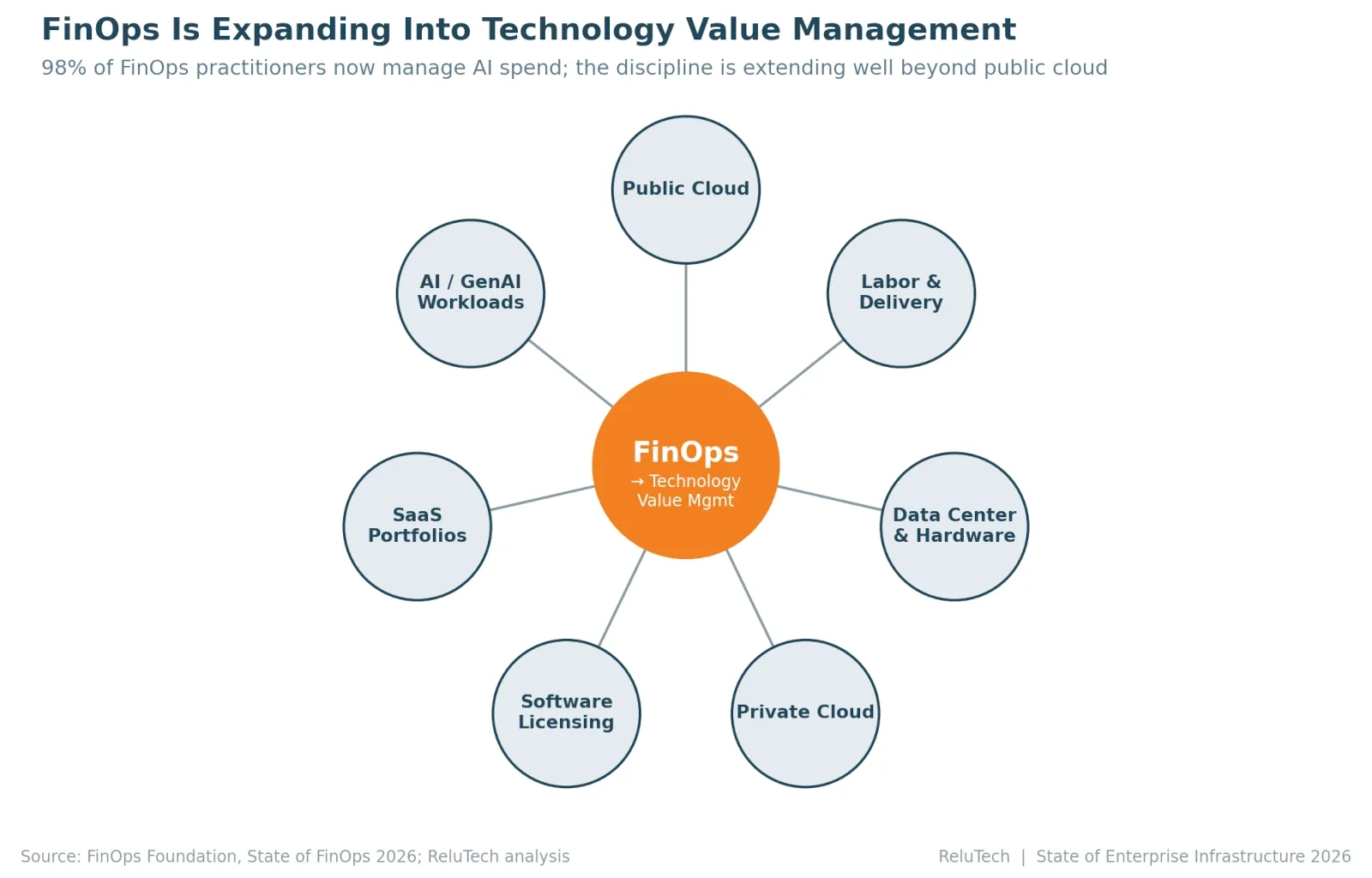
FinOps began as a response to public cloud cost overruns. It is now maturing into a broader discipline for managing technology value. The FinOps Foundation reports that 98% of practitioners now manage AI spend — up sharply from prior years — and the discipline is extending into SaaS, software licensing, private cloud, data center spend, and in some organizations, labor costs.
Flexera's 2026 research adds a sobering counterpoint: wasted cloud spend rose to 29%, reversing five consecutive years of decline. Organizations can adopt FinOps practices and still watch waste grow when overall spend rises faster than governance matures. AI makes the problem harder: usage scales quickly, unit costs are unfamiliar, and business teams experiment before cost controls exist. The same research shows the response taking shape: 71% of organizations now operate a Cloud Center of Excellence, 63% have dedicated FinOps teams, and nearly half use unit economics to connect cost to outcomes.
The future of FinOps is not spend reduction. It is value demonstration. That means connecting infrastructure spending to business outcomes, workload economics, unit costs, commitments, utilization, and modernization decisions — and extending cost governance across the full infrastructure portfolio rather than the cloud bill alone.
ReluTech Insight: FinOps and infrastructure lifecycle strategy belong in the same conversation. Cloud waste, OEM maintenance renewals, VMware costs, idle hardware, and stranded assets are all facets of one executive question: how do we convert infrastructure spend into business value?
How ReluTech helps: ReluTech's Migration IQ converts maintenance savings, asset recovery value, and support alternatives into a single funding model your CFO can act on. If your FinOps practice stops at the cloud bill, request a Migration IQ estimate and extend it to the rest of the portfolio.
Trend 8: Skills Shortages Delay Modernization
Technology strategy tends to assume that organizations can execute once the business case is approved. The labor market says otherwise. Infrastructure modernization requires cloud architects, virtualization specialists, network engineers, security teams, data engineers, AI infrastructure talent, FinOps practitioners, and project leaders who can coordinate complex migrations — all at the same time.
IDC estimates that 90% of organizations worldwide will feel the IT skills crisis by 2026, with substantial costs tied to delays, quality issues, and missed revenue. AI skills rank among the hardest to source. These gaps are not abstract: they appear as stalled migrations, delayed decommissions, cloud cost overruns, weak documentation, poor operational handoffs, and extended dependence on aging platforms.
The skills shortage also rewrites modernization economics. A migration plan that looks attractive on paper fails if internal teams lack capacity to execute it. Conversely, the right external talent — placed at the right phase — can convert a perpetually delayed project into a funded, scheduled initiative.
ReluTech Insight: Modernization delays are often labeled technical blockers when they are actually capacity blockers. The ability to supply specialized talent on demand is as strategically important as the ability to supply hardware, support, or cloud expertise.
How ReluTech helps: ReluTech's NerdRabbit division places vetted cloud, infrastructure, and AI talent on demand — from a single contractor to a full migration team. If a funded project is stalled on capacity, tell us where your roadmap is stuck.
Trend 9: Sustainability Collides With AI Growth
Enterprise sustainability goals are colliding with the power appetite of AI infrastructure. Data centers spent a decade improving efficiency, but industry research indicates average PUE improvements have plateaued while total power demand keeps rising. The uncomfortable arithmetic: even highly efficient facilities consume dramatically more energy when total compute demand grows fast enough.
AI sharpens the issue because it concentrates demand in high-density environments. More GPUs, more memory, more networking, and more cooling all expand the physical footprint of digital growth. The pressure lands on cloud providers, colocation operators, utilities, regulators, and every enterprise that made public sustainability commitments before the AI buildout began.
The sustainability conversation therefore needs to expand beyond renewable energy procurement. It should include lifecycle extension, responsible IT asset disposition (ITAD), reuse and resale, certified data destruction, embodied carbon accounting, and the avoided waste of maximizing useful asset life. Every server kept productively in service is embodied carbon that doesn't need to be manufactured twice.
ReluTech Insight: Sustainability in the AI era is not only about buying renewable power. It is about using existing infrastructure intelligently: avoiding unnecessary refreshes, recovering value from retired assets through R2v3-certified ITAD, and decommissioning responsibly when workloads move.
How ReluTech helps: ReluTech's R2v3-certified ITAD recovers value from retired infrastructure with certified data destruction and full chain of custody — turning decommissioned assets into both a sustainability win and a funding source. Request an asset recovery estimate before your next decommission.
Trend 10: Infrastructure Economics Become Strategic
The through-line across every trend in this report is economics. AI demands more capital. Cloud spend keeps rising. VMware renewals have become unpredictable. Data center capacity is constrained. Skills are expensive. Sustainability commitments are harder to meet. And legacy infrastructure still needs support while modernization projects unfold.
This is why infrastructure decisions increasingly belong in business conversations, not just technical ones. The CFO, CIO, CISO, procurement, facilities, and application owners all hold a stake in workload placement, lifecycle planning, support strategy, cloud commitments, and asset disposition. The organizations that perform best in 2026 will be the ones that put those stakeholders in front of a single, integrated business case.
The practical shift is from category-by-category purchasing to portfolio-level economics: maintenance savings funding migration, asset recovery funding AI pilots, support continuity de-risking platform transitions, and talent capacity determining what's actually executable this fiscal year.
ReluTech Insight: The next best action for most enterprises is not a tool purchase. It is an infrastructure business case that quantifies savings, funding sources, timing risk, support options, and migration choices in one view — so every decision can be defended in front of the CFO.
The ReluTech Infrastructure Readiness Index
Industry data tells you where the market is going. It does not tell you whether your environment is ready to go with it. The ReluTech Infrastructure Readiness Index is a five-dimension framework for evaluating whether an enterprise infrastructure estate is prepared for the next wave of cloud, AI, and modernization pressure. It is simple enough to score in one meeting and structured enough to drive a real plan.
Each dimension is scored from 1 to 10. A total below 25 indicates a constrained environment. A total of 25–39 indicates a developing environment. A total of 40–49 indicates a mature environment. A total of 50 represents an AI-ready, financially governed, fully flexible infrastructure posture.
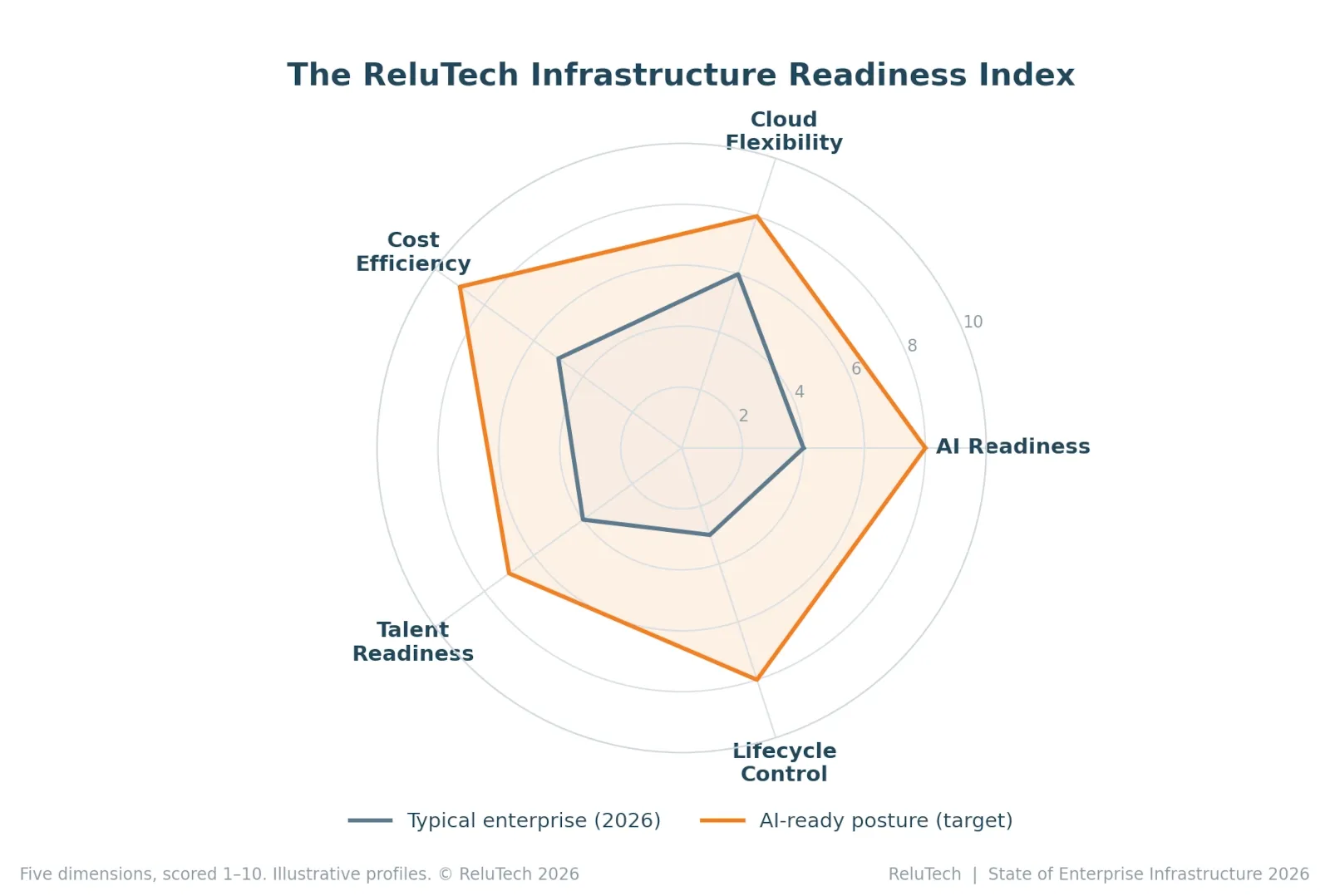
| Dimension | Constrained (1–3) | Developing (4–7) | Mature (8–10) |
|---|---|---|---|
| AI readiness | No AI infrastructure plan; unclear data strategy. | Pilots underway; limited cost and capacity modeling. | Clear AI workload strategy with governed infrastructure paths. |
| Cloud flexibility | Workloads tied to one environment with poor portability. | Some portability; inconsistent governance. | Workloads placed by cost, performance, compliance, and business value. |
| Cost efficiency | Cloud, OEM, and platform costs managed reactively. | FinOps or procurement controls exist but are siloed. | Unified technology value management across cloud, hardware, licensing, and support. |
| Talent readiness | Modernization depends on overloaded internal teams. | Some external support; skills gaps remain. | Clear staffing model for cloud, AI, infrastructure, and operations. |
| Lifecycle control | Refresh, support, ITAD, and asset recovery are disconnected. | Some lifecycle planning tied to projects. | Asset lifecycle strategy actively funds and de-risks modernization. |
How to use the index
- Score each of the five dimensions from 1 to 10, ideally with input from infrastructure, finance, and application owners.
- Identify your two weakest dimensions; these are where modernization plans most often stall.
- Map each weakness to a business risk: cost, capacity, compliance, delay, talent, or platform lock-in.
- Use the result to prioritize the next move: a modernization business case, a Migration IQ estimate, a maintenance review, a VMware assessment, or an ITAD and asset recovery strategy.
Quick Answers: Enterprise Infrastructure in 2026
What are the biggest enterprise infrastructure trends in 2026?
The biggest enterprise infrastructure trends in 2026 are the AI infrastructure supercycle, hybrid cloud as the default operating model, selective cloud repatriation, the VMware/Broadcom platform reassessment, power and cooling constraints, the expansion of FinOps into technology value management, renewed data center investment, IT skills shortages, and the collision between sustainability goals and AI growth.
How much will enterprises spend on IT in 2026?
Gartner forecasts worldwide IT spending of $6.31 trillion in 2026, up 13.5% from 2025. Data center systems are the fastest-growing category at 55.8% growth, reaching roughly $788 billion, driven primarily by AI infrastructure investment.
Why is AI changing enterprise infrastructure strategy?
AI changes infrastructure strategy because it requires high-performance compute, large-scale storage, specialized networking, greater power density, stronger cost governance, and new operational skills. Even companies not building their own AI clusters are affected, because hyperscaler demand drives up prices and lead times for chips, memory, cloud capacity, and data center space across the entire market.
Is cloud repatriation a sign that cloud failed?
No. Cloud repatriation in 2026 is workload optimization, not cloud failure. Enterprises move selected workloads to private or on-premises environments when cost, latency, compliance, data sovereignty, or predictability justify it — while continuing to grow overall cloud usage. Only a small percentage of organizations pursue full repatriation.
Why are enterprises evaluating VMware alternatives?
Enterprises are evaluating VMware alternatives because Broadcom-era changes have shifted the business case for staying: elimination of perpetual licenses, subscription requirements, bundle consolidation, core minimums, and significant renewal increases. Common alternatives include public cloud, Nutanix, Hyper-V, Proxmox, KVM, and OpenShift Virtualization — often combined with third-party support to extend decision runway.
What is the future of hybrid cloud?
Hybrid cloud will remain the default enterprise architecture because workloads have fundamentally different requirements. 73% of organizations already operate hybrid estates, and the share is rising. The future of hybrid is intentional workload placement, unified governance across every environment, and lifecycle planning that connects on-premises and cloud costs into a single infrastructure economics model.
Primary Sources
- Gartner, Worldwide IT Spending Forecast (October 2025, February 2026, April 2026 updates).
- IDC, Worldwide Quarterly Artificial Intelligence Infrastructure Tracker (Q4 2025 release, April 2026).
- Flexera, 2026 State of the Cloud Report (n=753 cloud decision-makers, March 2026).
- FinOps Foundation, State of FinOps 2026.
- McKinsey & Company, data center capital expenditure analyses, 2025.
- Uptime Institute, Global Data Center Survey, 2025.
- IEA, Energy and AI / data center electricity demand research.
- Deloitte, Tech Trends and AI infrastructure research.
- Public reporting and survey data on VMware/Broadcom licensing changes and migration intent.
Where to Go From Here
- Get an Infrastructure Readiness Assessment. Take the assessment and receive a scored snapshot of your environment across all five dimensions.
- Request a Migration IQ estimate. Quantify how hidden data center costs can fund your cloud migration before committing capital.
- Evaluate options before your next VMware renewal. Model renewal, negotiation, third-party support, and migration scenarios side by side.
- Review your workload placement. Identify workloads where cost, risk, or timing justify a new placement strategy.
- Recover value from idle assets. Find out whether retired or underutilized infrastructure can fund modernization.
About ReluTech: ReluTech is an Atlanta-based IT solutions company helping enterprises modernize on their own timeline. As an AWS Advanced Tier Services Partner with R2v3-certified asset disposition, ReluTech connects third-party hardware maintenance, IT asset disposition, infrastructure buy-sell-lease, AWS cloud migration, and technical talent placement into a single infrastructure economics conversation. Learn more at relutech.com.
© 2026 ReluTech · relutech.com
