Seven practical questions to help IT leaders evaluate hardware maintenance coverage, contract flexibility, and long-term infrastructure value.

When comparing data center maintenance companies in 2026, it is easy to start with the annual quote and a four-hour response commitment. Both matter. Neither tells you the whole story. The real test is whether a provider can protect the equipment your business depends on, explain how support will work when something fails, and help you avoid paying for coverage or hardware you no longer need.
That distinction becomes especially important in mixed-OEM environments and during infrastructure changes. A data center that is consolidating facilities, retiring servers, or moving workloads to the cloud has a different maintenance problem than one planning to keep every rack for another five years. Your provider should be able to support the assets and timeframes you actually have.
The short answer: Compare every provider on hardware eligibility, real-world SLA execution, parts and engineering, contract flexibility, asset visibility, end-of-life value, and alignment with your infrastructure roadmap. Ask for the details in writing, not just a percentage-off claim.
Why a cheaper maintenance quote may cost more in the long run
Third-party maintenance (TPM) can be an effective way to extend the useful life of servers, storage, and networking equipment without committing to an immediate refresh. But the cheapest headline rate is not necessarily the lowest total operating cost. A quote may look attractive until you discover that critical devices are excluded, parts availability varies by location, or the contract extends beyond the date you plan to retire a site.
An apples-to-apples comparison needs to distinguish price, coverage, operating risk, and contract exposure.
| What the proposal says | What the buyer still needs to verify |
|---|---|
| “24x7 support” | Does this refer to the help desk, onsite engineering, replacement parts, or all three? |
| “Four-hour response” | Four hours to acknowledge, dispatch an engineer, arrive onsite, or restore service? |
| “Multivendor coverage” | Which exact models, serial numbers, firmware dependencies, and locations are covered? |
| “Flexible terms” | Can you remove or reduce coverage midterm as equipment is retired? |
| “Lower maintenance costs” | How do exclusions, spares, site fees, escalation, and termination terms affect total cost? |
The following seven questions turn those gray areas into a practical evaluation framework.
1. Does the provider cover the exact hardware you need to keep running?
Start with the equipment, not the vendor brochure. Build a complete inventory by OEM, product family, model, serial number, software or firmware dependency, site, and criticality. Then ask each data center maintenance company for a device-level coverage confirmation, including exclusions.
A useful response separates server, storage, and network support rather than treating all devices as interchangeable. A legacy storage array may require a different diagnostic process and parts strategy than an Ethernet switch or a rack-mounted server. Devices at end of life (EOL) or end of service life (EOSL) need particular scrutiny because original manufacturer support and updates may change or stop.
Ask for: A line-item coverage matrix and a clear statement of which components, software assistance, firmware updates, and replacement parts are included. Independent hardware maintenance does not automatically provide OEM-controlled software patches, firmware entitlements, or security updates. Resolve those needs separately before signing.
2. What happens after a critical support ticket is opened?
An SLA is valuable only when everyone agrees on what its clock measures. A “four-hour” commitment might mean engineer arrival, part delivery, a response from the help desk, or something else. Those outcomes are not equivalent when a production system is down.
Have the provider walk through an actual severity-one incident. Who receives the call? When does remote triage begin? Who authorizes a field dispatch? Where will the replacement part come from? What happens if the first part does not solve the problem? Ask how escalation works after business hours and across regions.
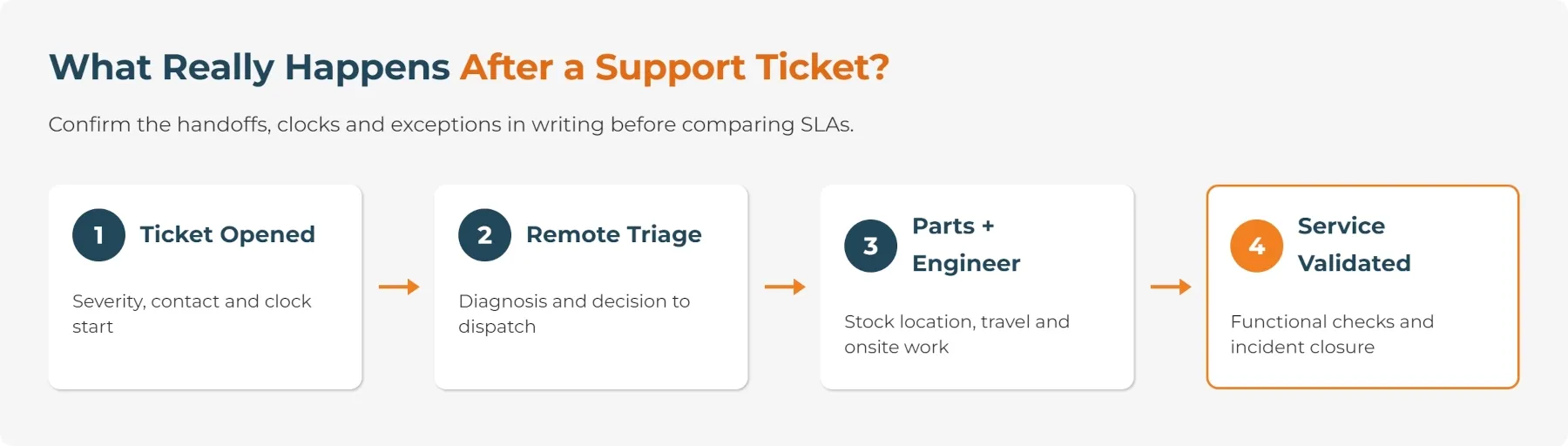
Ask for: The SLA definitions, exclusions, escalation path, parts commitments, engineer coverage, and a sample incident or service report. Compare acknowledgement, onsite response, and resolution as separate measures. If uptime matters, request evidence of how the provider handles repeat faults and difficult escalations.
Uptime Institute's 2026 Annual Data Center Outages Analysis reinforces why operational resilience deserves more attention than marketing language about response times.
3. Can the provider actually get the right part and engineer to the right site?
Hardware maintenance is a logistics service as much as a support contract. Remote diagnosis will not restore a failed device if a compatible part is unavailable or a qualified engineer cannot get onsite.
Ask where critical spares are stocked, how compatible replacements are validated, and what happens when a part is scarce. For remote sites or highly specialized systems, request a plan for onsite stocking or alternative sourcing. Also verify who performs field service, how engineers are vetted, and how the service team coordinates with your change-control procedures.
A vendor that can support many OEMs may reduce administrative overhead, but broad OEM lists should not substitute for proof of support on the particular equipment you own.
Ask for: A site-by-site support plan, parts sourcing approach, field-engineer coverage map, and exception process for hard-to-source models. Where feasible, validate the proposed process on a limited set of devices before a wider transition.
4. Can the maintenance agreement change when your infrastructure changes?
This is one of the most important questions for companies managing a data center exit, hardware refresh, or cloud migration. Workloads move in phases. Hardware stays online until cutover and validation are complete. A contract that looks reasonable for today's environment may become expensive if it continues to charge for retired assets.
Do not assume “flexible” means month-to-month or automatically removable coverage. Ask when devices can be added, removed, or repriced; whether the provider allows site consolidation; whether credits are available for early asset retirement; and how renewals and notice periods work. Review any minimum spend, fixed term, and termination language.
Ask for: A written change-order example showing what happens if 25 percent of covered equipment retires halfway through the term. The purpose is not to demand a universal contract model. It is to understand the financial exposure before your infrastructure footprint changes.
Practical check: If a provider's proposal assumes every server stays for the entire term, have it reprice the contract against your actual migration or decommissioning schedule.
5. Will you have visibility into the assets, contracts, renewals, and support activity?
When maintenance data sits across spreadsheets, ticketing systems, and different vendor portals, teams can lose track of what is covered, what has expired, and what is being billed. Better visibility makes it easier to validate service delivery and prevent unnecessary renewals.
Ask what the provider's customer portal actually shows. Can you find coverage by serial number? Review contract end dates? Track tickets and open incidents? Export data for finance, procurement, and infrastructure teams? Does the provider support periodic reviews to reconcile inventory against the live environment?
Ask for: A live portal demonstration using representative assets, a sample renewal report, export formats, and ownership details for asset data. Clear reporting is especially useful when different OEMs and multiple locations are involved.
6. What happens to the hardware when you no longer need it?
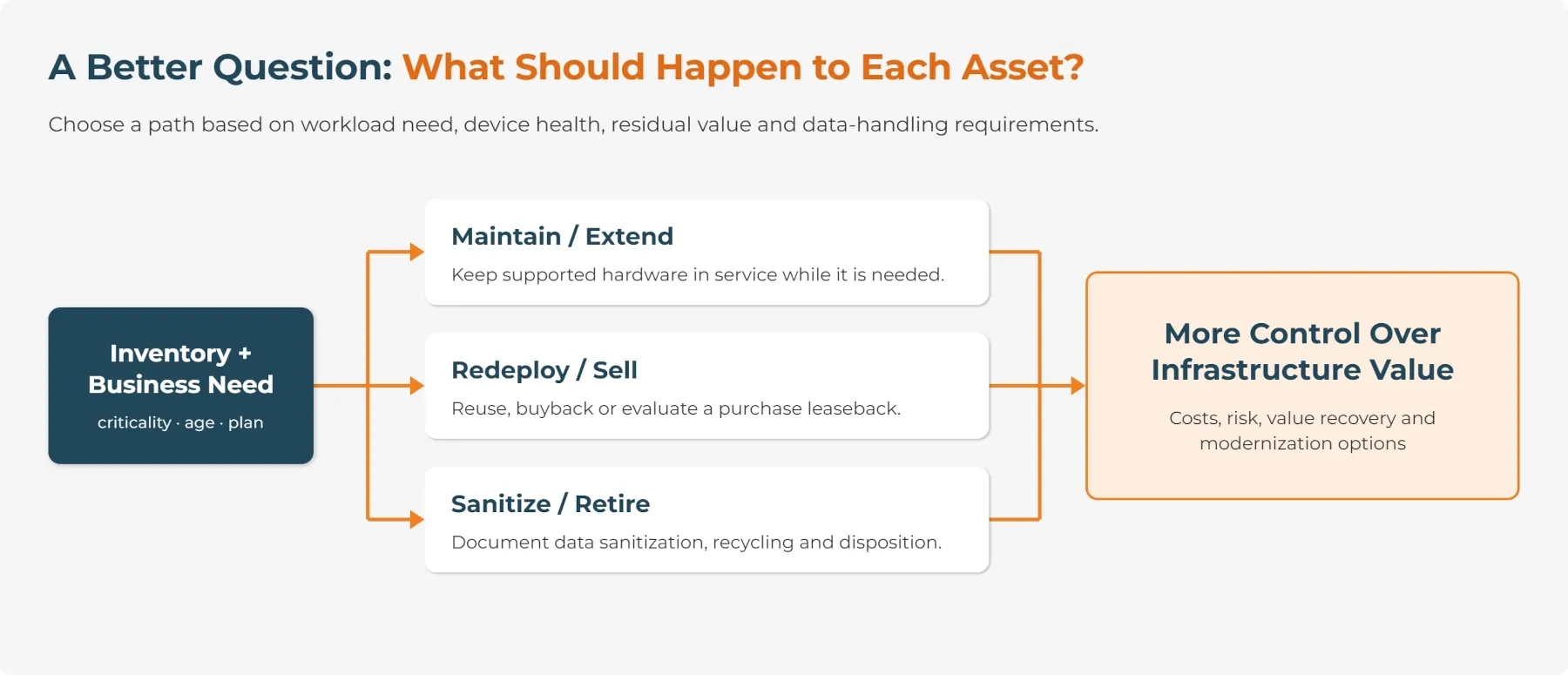
A server that leaves production is not automatically worthless. Depending on its model, age, condition, and demand, it may be suitable for reuse, resale, or a hardware buyback. Other equipment may need secure data destruction and certified recycling. A maintenance provider that can coordinate these next steps may simplify the process, even when those services are contracted separately.
There is also a potential cash-flow consideration. A purchase leaseback arrangement may allow an organization to sell eligible hardware while continuing to use it for an agreed period. It is not appropriate for every environment, but it can be worth evaluating when a migration or facility exit is underway and useful assets still have residual value.
For retired storage media, require a documented sanitization and chain-of-custody process. NIST SP 800-88 Revision 2, published in September 2025, provides guidance for establishing a media sanitization program based on information sensitivity.
Ask for: Buyback or leaseback eligibility criteria, valuation assumptions, data sanitization methods, custody documentation, certificates, and reporting on reuse or recycling. Compare the full commercial terms, not just the headline buyback offer.
7. Can the provider support where your infrastructure is going, not just where it is today?
Your data center maintenance strategy should fit a three-to-five-year technology plan, even if the maintenance agreement itself is much shorter. That plan may involve staying on premises, running a hybrid environment, moving selected workloads to a public cloud, refreshing only critical systems, or exiting a facility.
A useful provider conversation connects today's hardware support with that future. Can it help you avoid a refresh on equipment that will be retired soon? Will coverage remain appropriate during a phased migration? Can you procure a needed replacement part without signing up for a larger refresh? Can assets be removed from coverage as they exit production? And can recovered asset value or avoided maintenance spending be evaluated as part of the broader modernization business case?
Not every TPM company needs to provide every adjacent service. The goal is to discover whether those activities are coordinated, clearly priced, and owned by accountable teams rather than becoming separate projects with unclear handoffs.
Ask for: A proposed support plan aligned to upcoming hardware milestones, the service owners for adjacent work, and an estimate of the financial effect of the options you are considering. Savings and asset recovery depend on the environment and should be modeled, not assumed.
The asset decision is not always a simple keep-or-retire choice. Map each device to the right path based on operational need, supportability, data requirements, and any recoverable value.
A seven-question scorecard for comparing providers
Use the same evidence standard for every vendor, whether it is an OEM, a current maintenance provider, or a new third-party maintenance company.
| Evaluation question | Evidence to request | What a strong answer looks like |
|---|---|---|
| 1. Exact device coverage | Serial-number coverage matrix | Eligible assets, exclusions, and software boundaries are explicit |
| 2. SLA execution | Definitions and sample escalation report | Separate, measurable steps for response, onsite action, and resolution |
| 3. Parts and engineers | Parts strategy and site coverage | Credible delivery plan for your actual models and locations |
| 4. Contract flexibility | Add/drop and termination examples | Clear adjustment rules as hardware retires or moves |
| 5. Asset visibility | Portal demo and reporting examples | Searchable assets, contracts, renewals, and support history |
| 6. End-of-life value | Valuation and ITAD process | Transparent recovery options and documented sanitization |
| 7. Roadmap alignment | Phased support and cost model | Plan reflects refresh, hybrid, migration, or exit timelines |
The best choice is not necessarily the provider with the most checked boxes. Weight the questions by your environment. A hospital running critical clinical systems may place the greatest weight on validated response procedures and parts. A company closing two sites may prioritize contract adjustment and timely equipment disposition.
What a more connected maintenance strategy looks like with ReluTech
ReluTech's approach starts with maintaining the hardware you still need while identifying opportunities to avoid unnecessary spend as your infrastructure changes. Elastic Maintenance supports eligible multivendor server, storage, and networking equipment, with coverage structured around the customer's operational requirements and transition timeline. Coverage and service terms are defined in the individual proposal.
ReluTech also offers tools and services that can connect maintenance to the broader lifecycle:
- RAMP asset management portal for visibility into assets, maintenance contracts, renewals, and service tickets.
- Hardware procurement and rentals when customers need parts, interim capacity, or another way to extend equipment life.
- Asset purchase leaseback and buyback options to evaluate whether legacy equipment can release capital while still serving an operational need.
- IT asset disposition (ITAD) for deinstallation, secure data handling, value recovery, and responsible downstream disposition.
- Cloud-transition support that can align remaining data center coverage with phased migration plans.
These are capabilities to evaluate together, not a promise that every engagement will deliver the same savings, contract structure, or financing outcome. What matters is creating a practical path from today's maintenance requirements to tomorrow's infrastructure plans.
There is customer evidence behind the maintenance cost conversation, too. In a published Vistaprint case study, ReluTech reports that the customer avoided lengthy renewals and saved hundreds of thousands of dollars on maintenance. That is a specific customer example, not a guarantee of similar results for every environment.
Switching providers does not have to be an all-or-nothing decision
If you already work with a maintenance provider, compare quotes at the point of a natural renewal or assess a defined group of assets first. A single site, OEM product family, or upcoming end-of-service-life event can provide a manageable starting point.
Give each candidate the same device list, criticality ratings, sites, term assumptions, and SLA requirements. Then review total contract exposure, operational handoffs, and transition risk with your infrastructure and procurement teams. A careful comparison should help you make a decision without disrupting support for production equipment.
Frequently asked questions
Are third-party data center maintenance services the same as OEM support?
Not necessarily. TPM commonly focuses on supporting eligible hardware, often including equipment beyond manufacturer service dates. OEM contracts may include proprietary software, firmware, patches, engineering entitlements, or other services that a third-party agreement does not automatically replace. Check device-level scope and all update entitlements.
How should I compare two maintenance quotes?
Use the same asset inventory and coverage requirements, then compare more than price. Check SLA definitions, parts sourcing, engineers, exclusions, renewal and termination terms, portal visibility, and what happens when devices are retired. Model total cost over the period you actually expect to use the equipment.
Can third-party maintenance support end-of-service-life hardware?
It may be able to support eligible hardware after OEM service ends, depending on parts, expertise, and the specific product. The supportability of hardware is different from access to OEM software patches or security fixes, so confirm both before extending the life of critical assets.
When should a company review its current TPM contract?
A review is useful before a renewal, major refresh, data center consolidation, cloud migration, or change in asset count. You do not have to wait for a service problem. Changes in your infrastructure plan may change the coverage you need.
See what your maintenance contract could do for you
If you are comparing data center maintenance companies, start with your existing environment. ReluTech can review eligible assets, support requirements, renewal dates, and planned infrastructure changes to help identify options for reducing unnecessary maintenance expense and improving flexibility.
Request a TPM Savings & Flexibility Review
Already have an incumbent provider? Start with an upcoming renewal, one site, or a defined group of devices. Let ReluTech show you how Elastic Maintenance could fit, then compare the proposal against your current contract.
